

mm

About Orthopedic Specialists

Orthopedic Specialists of Seattle provides new and advanced procedures including endoscopic carpel tunnel release surgery for carpal tunnel syrome, complex joint restoration procedures, anterior approach hip replacement surgery, and more.

Ganglions Cysts of the Wrist

Finding a lump on your hand or wrist can be a frightening experience. But most of the time, these are harmless ganglion cysts, or wrist cyst, that will often disappear in time.

Commonly, ganglion cysts grow on the top of the wrist (dorsal ganglions). But they can also be found on the underside of the wrist (between the thumb and your pulse point), at the end joint of a finger or at the base of a finger.

A ganglion grows out of a joint, like a balloon on a stalk that rises out of the connective tissues between bones and muscles. Inside the balloon is a thick, slippery fluid similar to the fluid in your joints. Usually, the more active you are, the larger the lump becomes; when you rest, the lump decreases in size.

What causes Ganglion Cysts?

No one knows what triggers the formation of a ganglion. Women are more likely to be affected than men, and ganglions are common among gymnasts, who repeatedly apply stress to the wrist. Because the fluid-filled sac puts pressure on the nerves that pass through the joint, some ganglion cysts may be painful.

Large ganglions, even if they are not painful, are unattractive. Smaller ganglions that remain hidden under the skin (occult ganglions) may be quite painful.

Examination and Diagnosis

Your doctor may ask you how long you’ve had the ganglion, whether it changes in size and if it is painful. He or she may apply pressure to see if there is any tenderness, or hold a penlight up to the cyst to see if the light shines through.

You will probably need to get an X-ray, so that the doctor can rule out conditions such as arthritis or a bone tumor. Sometimes, an MRI or ultrasound is needed to find a ganglion cyst hidden under the skin.

Wrist Cyst Treatment Options

The first course of treatment is nonsurgical and conservative.

  • Observation. Because the ganglion is not cancerous and may disappear in time, the physician may recommend just waiting and watching to make sure that no radical changes occur.
  • Immobilization. Activity often causes the ganglion to increase in size, thus increasing the pressure on nerves and causing pain. Your physician may recommend that you wear a wrist brace or splint to relieve symptoms and allow the ganglion to decrease in size. As pain decreases, your doctor may prescribe exercises to strengthen the wrist and improve range of motion.
  • Aspiration. If the ganglion causes significant pain or severely limits your activities, you may choose to have the doctor drain the fluids with a procedure called “aspiration.” The doctor will numb the wrist and puncture the cyst with a needle to remove the fluid.
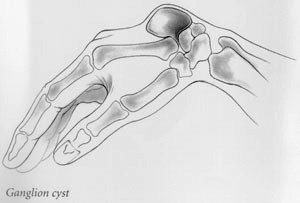
Ganglion CystThese treatments leave the outer shell and the stalk of the ganglion intact, so it may reform and reappear. Outpatient surgery can remove the ganglion, but is no guarantee that the cyst will not recur. Part of the involved joint capsule or tendon sheath may also be removed.

This is of little concern, but afterwards you may feel some tenderness, discomfort and swelling. You should be able to resume normal activities in two to six weeks.

Wrist Injuries

Wrist injuries can occur during many activities. These include sports and recreation, work-related tasks, work or projects around the home, accidents and falls, and fistfights. The risk of a wrist injury is higher in contact sports such as wrestling, soccer, and football. Injuries can occur during high-speed sports such as in-line skating, snowboarding, skiing, and biking.

Wrist Sprains

The most common sporting injury to the wrist is a wrist sprain. There are many ligaments in the wrist that can be torn or stretched, resulting in a sprained wrist. This commonly occurs when the wrist is bent forcefully or in a fall onto an outstretched hand. Sprains to the wrist can range from mild to severe and are graded depending upon the degree of ligament injury that exists.

Grade 1 – mild sprain where the ligaments are stretched but not torn
Grade 2 – moderate sprain where the ligaments are partially torn
Grade 3 – severe sprains that occur when there is significant complete tearing of ligaments

With grade 1 sprains, there is some mild discomfort and decreased range of motion. With grade 2 sprains there is more serious loss of function. Grade 3 sprains result when the ligament tears away from the bone and require surgical treatment. Many times this tearing leads to a small chip of the bone being torn away with the ligament. This is known as an avulsion fracture.

The most common symptoms of a wrist sprain include:

  • Swelling of the wrist
  • Bruising or discoloration of the skin around the wrist
  • Pain at the time of the injury
  • A feeling of popping or tearing inside the wrist
  • Persistent pain when you move your wrist
  • Tenderness at the injury site
  • A warm or feverish feeling to the skin around the wrist

Most sprains can be treated with immobilization and rest. However, your orthopedic specialist may have to perform surgery to correct your wrist injury. This all depends on the severity of the sprain and intensity of the torn ligament. Surgery involves reconnecting the ligament to the bone. This procedure is followed by a period of rehabilitation with exercises to strengthen your wrist and restore motion.

Although the ligament can be expected to heal in 6 to 8 weeks, rehabilitation for a full recovery could take several months.

Other Injuries of the Wrist

Tendinosis – This is a syndrome that involves a series of very small tears (called microtears) in the tissue in and around the tendon. Common symptoms are pain, tenderness, decreased strength of the wrist, and limited movement.

De Quervain’s Tendonitis
– This can occur in the hand and wrist when the thumb extensor tendons and the sheath covering these tendons swells and becomes inflamed. This leads to pain, tenderness, and decrease in motion of the wrist.

Carpal Tunnel Syndrome – This is caused by pressure on the median nerve in the wrist. The symptoms of this syndrome include numbness, tingling, weakness, and pain in the fingers, hand and wrist areas.

Colles’ Fracture – This type of fracture is a break across the radius that occurs when the hand is extended out during a fall. The break occurs causing the wrist to become shortened and extended. Teens that enjoy outdoor sporting activities often develop these types of fractures because falls often occur.

Symptoms of a Colles’ fracture include inability to straighten the wrist or to hold heavy objects, distortion in the shape or angle of the forearm above the wrist, and pain and swelling of the injured area. Many of these fractures are not severe and you can be placed in a splint and sling. Sometimes, the orthopedic specialist applies a fiberglass cast.

More severe fractures may require surgery including placement of pins or plates and screws. Recovery from this injury ranges from 6 weeks to 6 months depending on the severity of the fracture.

Waterproof Cast FAQs

Orthopedic Specialists of Seattle can help with broken bones. OSS aids in Fracture Care and offers Waterproof Casting. OSS sees both children and adults, many of whom are pleasantly surprised that they can stay active with a cast!

How does it work?
AquaCast and Gore-Tex are the most recent generation of waterproof cast paddings and liners. Their enhanced features are extremely comfortable and stretchable. These casts are made of a special type of fiberglass and covered by a waterproof cast liner on the outer shell.

The lining prevents the water from being in contact with the actual cast. The special cast and cover adhere around your arm or leg to make sure no water passes through. The AquaCast and Gore-Tex are products that are breathable, washable and waterproof.

Can I get the cast wet in the shower or bath?
Yes! The AquaCast and Gore-Tex liners will not absorb water and are moisture vapor permeable.

Can I swim in it?
Yes! Swimming is no longer a problem. Just be sure to rinse the chlorine or saltwater off afterwards.

Can I exercise?
Yes! Perspiration will not damage the AquaCast and Gore-Tex products. You should be sure to rinse it thoroughly with clean water after your physical activity.

Can I wash it?
Yes! Washing the cast will reduce odor, eliminate irritation and improve overall skin condition. Water or soap & water can be used for washing. However, please note that if soap is not rinsed thoroughly, this could cause skin irritation. So, when washing it is best to be gentle & rinse well.

How do I dry my cast?
For most people, the cast will dry in less than 90 minutes. Humidity levels, your body temperature, your activity level and the ambient temperature are all factors that will affect drying time. To speed up the drying time process, the use of a hair dryer on a cool setting can help.

OSS wants you to be able to maintain your daily lifestyle, even when a broken bone happens. If you or your child needs a waterproof cast, please feel free to call 206-784-8833.