
The elbow becomes dislocated when the joint surfaces are separated. With a complete dislocation, the joint surfaces are separated completely. The joint surfaces are only partly separated with a partial dislocation, also called a subluxation. The elbow is a hinge joint as well as a ball-and-socket joint. Injuries and dislocations to this structure can affect the normal range of motion. Elbow dislocations are either simple or complex. With simple dislocations, there is no major bone injury. With complex dislocations bones and ligaments are injured.
Cubital Tunnel
Cubital Tunnel – Numb hand from nerve pinched at the Elbow
 What is Cubital Tunnel Syndrome?
Cubital tunnel syndrome is a condition brought on by increased pressure on the ulnar nerve at the elbow. The ulnar nerve controls muscles used for gripping and the coordination of fine movements. The nerve passes through the cubital tunnel, a bony passageway. Cubital tunnel syndrome occurs when the ulnar nerve is compressed as it passes through this tunnel behind the elbow. When compressed, the ulnar nerve causes the sharp, tingling sensation that you feel when you hit your “funny bone.”
Ulnar Nerve Entrapment
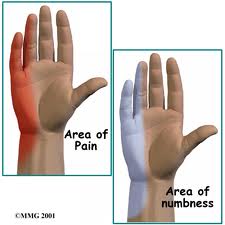
Ulnar nerve entrapment occurs when one of the nerves in the arm (the ulnar nerve) becomes compressed and can’t function normally. This can give symptoms of “falling asleep” in the ring finger and little finger, especially when the elbow is bent. You may have aching pain on the inside of the elbow.
In some cases, you may have trouble moving the fingers in and out, or manipulating objects. Carpal tunnel syndrome has similar symptoms but involves a different nerve (the median nerve). Carpal tunnel syndrome typically causes tingling in the thumb, index finger and long finger.
Tennis Elbow (Lateral Epicondylitis)
Tennis elbow is a degenerative condition of the tendon fibers that attach on the bony prominence (epicondyle) on the outside (lateral side) of the elbow. The tendons involved are responsible for anchoring the muscles that extend or lift the wrist and hand.
Radial Head Fractures
Trying to break a fall by putting your hand out in front of you seems almost instinctive. But the force of the fall could travel up your lower forearm bones and dislocate your elbow. It also could break the smaller bone (radius) in the forearm. The breaks can occur at the wrist (Colles fracture), or near the elbow at the radial “head.”
Radial head fractures are common injuries, occurring in about 20 percent of all acute elbow injuries. They are more frequent in women than in men and occur most often between 30 and 40 years of age. Approximately 10 percent of all elbow dislocations involve a fracture of the radial head. As the upper arm bone slides back into its appropriate place after the dislocation, it can chip off a piece of the radial head, resulting in a fracture.