Wrist Joint Replacement (Arthroplasty)

Most people are familiar with joint replacement surgery for the hip, knee, and shoulder joints. Joint replacement surgery in the wrist is less common but can be an option if you have painful arthritis that does not respond to other treatments.

Anatomy of the wrist
The wrist is a more complicated joint than the hip or the knee. At the base of the hand are two rows of bones, with four bones in each row. These are called the carpals. The long thin bones of the hand radiate out from one row of carpals toward the fingers and thumb. The two bones of the lower arm (radius and ulna) form a joint with the other row of carpals. All the bone ends are covered with a slick, elastic tissue called cartilage, which enables the bones to move smoothly against each other. However, if the cartilage is worn away or damaged by injury, infection or disease, the bones will rub against each other causing pain. During any total joint replacement, the worn-out bone ends are removed and replaced by an artificial joint (prosthesis).

Reasons for wrist replacement surgery
The typical candidate for wrist replacement surgery has severe arthritis but does not need to use the wrist to meet heavy demands in daily use. The primary reasons for wrist replacement surgery are to relieve pain and to maintain function in the wrist and hand.

  • Osteoarthritis, the most common form of arthritis, results from a gradual wearing away of the cartilage covering on bones.
  • Rheumatoid arthritis is a chronic inflammatory disease of the joints that results in pain, stiffness and swelling. Rheumatoid arthritis usually affects several joints on both the right and left sides of the body.

Both forms of arthritis may affect the strength of your fingers and hand, making it difficult for you to grip or pinch. In some cases, fusing the wrist bones together will reduce or eliminate pain and improve grip strength. However, if the bones are fused together, you will not be able to bend the wrist. Wrist replacement surgery may enable you to retain or recover wrist movements and improve your ability to perform daily living activities, especially if you also have arthritis in the elbow and shoulder.

Implant design
Wrist implants are made of the same kind of materials used for hip and knee joint replacements. There are several different designs. Most have two components and are made of metal; a high quality plastic called polyethylene is used as a spacer between the two components. Newer implant designs try to replicate the anatomy of the wrist.

The piece that attaches to the lower arm (radius bone component) fits into the bone of the lower arm. The top of this component has a curve that matches to the wrist part. The piece that attaches to the hand (carpal component) may have one long stem and one or two shorter stems that insert into the hand bones, or use small screws. The surface of this component is flat. The plastic spacer comes in different sizes so it can be matched to your hand. It is normally flat on one side and rounded on the other. This design enables it to fit into the carpal component while it rocks on the radial component, creating a more natural wrist motion.

Implant insertion
A wrist joint replacement can be done as an outpatient procedure, unlike a hip or knee replacement. Wrist replacement surgery is often combined with other procedures to correct deformities or disorders in the tendons, nerves, and small joints of the fingers and thumb.

The incision is made on the back of the wrist. The damaged ends of the lower arm bones are removed and the first row of carpal bones may also be removed. The radial component of the prosthesis is inserted into the center of the radius bone on the outside of the lower arm. It is held in place with bone cement. Depending on the component design, the carpal component is then inserted into the center hand bone (third metacarpal) or screwed into the remaining row of carpal bones. Bone cement may be used to hold the component in place. The carpal bones may be linked or fused together to better secure this component.

An appropriately sized spacer is used between the metal components.

After your surgery
You will have to wear a cast for the first several weeks. When the cast is removed, you will have to wear a protective splint for the next six to eight weeks. Although pain relief is immediate, you will have to do gradual exercises for several weeks to restore movement and, eventually, to increase power and endurance. Wrist arthroplasty can improve motion to about 50 percent of normal.

The physical demands that you place on the wrist prosthesis will have an effect on how long the implant lasts. You will not be able to use a hammer often or pneumatic tools. You may only be able to lift a limited amount of weight. A fall on the outstretched hand may break the prosthesis, just as it might fracture a normal wrist. So you will want to avoid activities such as roller sports that could result in a fall.

Although there have been significant advances in wrist prostheses, the implant may loosen or fail due to wear or deformation. In these cases, additional surgery may be necessary. On average, a wrist replacement can be expected to last 10 to 15 years with careful use. As with all implants, long-term follow-up is advised. Generally, you should see your hand surgeon every year or two years so that x-rays can be taken and used to identify any developing conditions or problems.

cons1_161_347

Wrist Arthroscopy

Arthroscopy (ar-THROS-ka-pea) is an outpatient surgical procedure used by orthopaedic surgeons to diagnose and treat problems inside a joint. The surgeon makes small incisions, less than half an inch long, and inserts a pencil-sized instrument called an arthroscope. The arthroscope contains a small lens, a miniature camera and a lighting system.

This projects three-dimensional images of the joint on a television monitor, enabling the surgeon to look directly inside the joint and identify the trouble. Tiny probes, forceps, knives and shavers can then be used to correct many problems at the same time.

Arthroscopy has been used for several years to treat conditions in large joints such as the knee and the shoulder. As cameras and instruments became smaller and more refined, arthroscopy was applied to other joints, including the wrist. The wrist is a complex joint, with eight small bones and many connecting ligaments. Arthroscopy enables the surgeon to see the anatomic parts and their movements and to make a more accurate diagnosis.

Diagnostic arthroscopy
Diagnostic arthroscopy may be used if the cause of your wrist pain cannot be identified or if wrist pain continues for several months despite nonsurgical treatment.

Before surgery, your doctor will do:

  • A physical examination that focuses on your hand and wrist. Your doctor will also ask about your medical history.
  • Provocative tests that involve moving your hand in ways that reproduce the pain.
  • Imaging studies, such as X-rays of your hand and wrist. In some cases, additional imaging studies may be needed. These can include an MRI (magnetic resonance image) or an arthrogram, in which a contrast agent is injected into the joint before the image is taken.

Usually, regional anesthesia is used during arthroscopic surgery. This numbs your arm and hand. You may also be given a sedative to further relax you and enable you to doze through the surgery. Two or more small incisions (portals) are made on the back of the wrist, through which the arthroscope and instruments are inserted. After the surgery, the incisions are closed with a small stitch and a dressing is applied. Sometimes a splint may also be used.

Arthroscopic surgical treatment

Several conditions can be treated using arthroscopic surgery, including chronic wrist pain, wrist fractures, ganglion cysts and tears in the ligaments or the triangular fibrocartilage complex (TFCC). Wrist arthroscopy may also be used to smooth the bone surfaces and remove inflamed tissue. Arthroscopy can also be used to surgically treat carpal tunnel syndrome, but in that diagnosis, the arthroscope is not inserted into the wrist joint itself.

  • Chronic wrist pain: Arthroscopic exploratory surgery may be used to diagnose the cause of chronic wrist pain when other tests are inconclusive. Often, there may be areas of inflammation, cartilage damage, or other findings after a wrist injury. In some cases, after the diagnosis is made, the condition can be treated arthroscopically as well.
  • Wrist fractures: Doctors can remove small fragments and fracture debris, align the broken pieces of bone, and stabilize them by using pins, wires, or screws.
  • Ganglion cysts: These cysts commonly grow from a stalk between two of the wrist bones. During an arthroscopic procedure, the surgeon can remove the stalk, which may also reduce recurrence of the cysts.
  • Ligament/TFCC tears: Ligaments are fibrous bands of connective tissue that link or hinge bones. They provide stability and support to the joints. The TFCC is a cushioning structure within the wrist. A fall on an outstretched hand can tear ligaments, the TFCC or both, resulting in pain with movement or a clicking sensation. During arthroscopic surgery, the surgeon can trim or repair the tears.
  • Carpal tunnel release: Carpal tunnel syndrome is characterized by numbness or tingling in the hand, and sometimes with pain up the arm. It is caused by pressure on a nerve that passes through the carpal tunnel, which is formed by the wrist bones and a thick tissue roof. Pressure can build up within the tunnel for many reasons, including irritation and swelling of the tissue (synovium) that covers the tendons. If the syndrome does not respond to conservative treatment, your doctor may recommend surgery to cut the ligament roof and enlarge the tunnel, thus reducing pressure on the nerve and relieving symptoms. This can sometimes be done using an arthroscope.

After surgery, you will need to keep your wrist elevated for the first two or three days and keep your bandage clean and dry. You can ice your wrist to help keep swelling down. Your doctor and/or your physical therapist will teach you exercises to help maintain motion and rebuild your strength. Analgesic medications will help relieve any postoperative pain, which is usually mild.

Complications
Complications during or after arthroscopic wrist surgery are unusual, but may include infection, nerve injuries, excessive swelling or bleeding, scarring or tendon tearing. An experienced surgeon, particularly one who specializes in treating the hand, can reduce the likelihood of complications.

Summary
Arthroscopic surgery is a valuable diagnostic and treatment tool. It is minimally invasive, and patients generally experience fewer problems and a more rapid recovery than with open surgery. Because it is an outpatient procedure, most patients are home several hours after surgery.

Trigger Finger

Description
A trigger finger is a common problem that causes pain and catching. Tendons that help bend the fingers and thumb slide through a snug tunnel. Irritation as the tendons slip into the tunnel can cause the opening of the tunnel to become smaller, or the tendon to thicken so that it can’t easily pass through the tunnel.

As you try to straighten the finger, the tendon becomes momentarily stuck at the mouth of the tunnel then pops as the tendon slips past the tight area. This can cause pain and catching as you try to move the finger. Your doctor can diagnose the problem by talking with you and examining your hand. No X-rays or other testing are usually needed.

Risk Factors/Prevention
It isn’t usually known what causes the problem. Trigger fingers are more common in women than men. They occur most frequently in people who are between the ages of 40 to 60 years. Trigger fingers are more common in people with certain medical problems such as diabetes and rheumatoid arthritis.

Symptoms
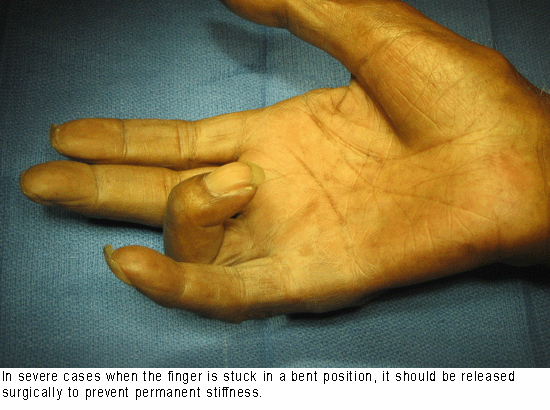
Symptoms usually start without any injury. You may feel pain in the palm, sometimes along with swelling or a small lump. You may feel the catching or popping sensation in the finger or thumb joints. Stiffness and catching tend to be worse after inactivity, such as when you wake in the morning, but will often loosen up with movement. When it breaks free, it may feel like the finger joint is dislocating. In severe cases the finger may become stuck in a bent position so that it can’t be straightened even with the help of other fingers. One or more fingers can be involved.

Treatment Options
If your symptoms are mild, simply resting the finger may be enough to relieve the problem. Over-the-counter medications such as Tylenol® or Advil® can be used for pain. Splints are sometimes used to rest the finger. Your doctor may recommend an injection that helps in most cases, but sometimes the improvement is temporary. More than one injection may be needed. Injections are less likely to bring about permanent relief when the triggering has been present for a long time, or if you have associated medical problems like diabetes. If the problem remains troubling, you may want to consider surgery.

cons1_385_168

Treatment Options: Surgical
A trigger finger isn’t a dangerous condition, so the decision whether to proceed with surgery is a personal one based on the severity of your symptoms. If the finger is stuck in a bent position, surgery may be recommended to prevent permanent stiffness. Surgery widens the opening of the tunnel so the tendon can slide through more easily. This is usually done through a small incision in the palm as an outpatient surgery.

Sometimes the tunnel can be safely opened with the tip of a needle in your doctor’s office. You can move the fingers immediately after surgery. Elevating the hand after surgery can help minimize swelling and pain. Some soreness in the palm is common but recovery is usually complete in a few weeks. If the finger was quite stiff before surgery, a therapist may help you to loosen up the finger.

Scaphoid (Wrist Bone) Fracture

cons1_383_253Description
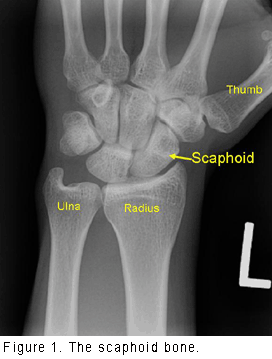
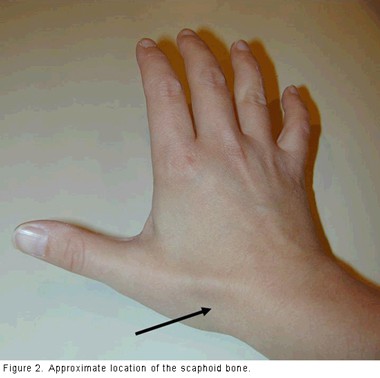
The scaphoid is one of the small bones in the wrist (carpal bones), and the one that is most likely to break. The scaphoid is located on the thumb side of the wrist, in the area where the wrist bends (see Figure 1).When you hold your thumb in a “hitch hiking” position, the scaphoid is at the base of the depression made by your thumb tendons. Pain or tenderness in this area can be a sign that the scaphoid is injured (see Figure 2).

A fracture of the scaphoid usually happens when you fall on an outstretched hand, with your weight landing on the palm. The end of the forearm bone (radius) may also break in this type of fall, depending on the position of the hand when you land. Pain and swelling in the wrist will usually cause a person with a scaphoid fracture to see a doctor. If the wrist is not deformed, however, you might not know that you have a broken bone–people sometimes think they have just sprained the wrist.

It is important to see your doctor if you have pain on the thumb side of the wrist that starts after a fall or accident and does not go away within a few days. The doctor will probably order X-rays to look at the bone.
cons2_383_253Sometimes, a broken scaphoid does not show up on an X-ray right away. When this is the case, the doctor may put your wrist in a splint and wait to take a new X-ray in a week or two, when the fracture may become visible. Keep the splint on and do not do any heavy lifting during the waiting time.

Your doctor might also recommend an MRI (magnetic resonance image) to see the bones and soft tissues. An MRI can sometimes show a fracture of the scaphoid before it can be seen on an X-ray.

Risk Factors/Prevention
Fractures of the scaphoid occur in people of all ages, including children. The injury often happens during sports activities or a motor vehicle accident. Men aged 20 to 30 years are most often affected.

There are no specific risks or diseases that increase the chance of having a scaphoid fracture. Some studies have shown that use of wrist guards during activities like inline skating and snowboarding can decrease the chance of breaking a bone around the wrist.

Symptoms
Scaphoid fractures usually cause pain in the base of the thumb, with swelling in the same area. You may have severe pain when you move your thumb or wrist or grip anything. Other times, the pain is not so bad, and you may mistakenly think that you just sprained your wrist.

Treatment Options
Treatment of scaphoid fractures depends on the location of the break in the bone. Sometimes, the scaphoid is broken at the end near the thumb. This part of the bone has a good blood supply. Scaphoid fractures in this location usually heal in a matter of weeks with proper protection. The time frame to healing is best determined by X-rays or other imaging studies such as a CT scan, which confirm that the bone has healed. Most fractures here heal well when they are placed in a cast. The cast will usually be below the elbow. It may or may not include the thumb.

More commonly, the scaphoid is broken in the middle (waist) or at the part closer to the forearm (proximal pole). This part of the scaphoid does not have a very good blood supply, so it is more difficult to heal. If your orthopaedist recommends that your scaphoid fracture be treated in a cast, it will probably include the thumb. Sometimes the cast will extend to above your elbow and may also include your index finger.

Treatment Options: Surgical
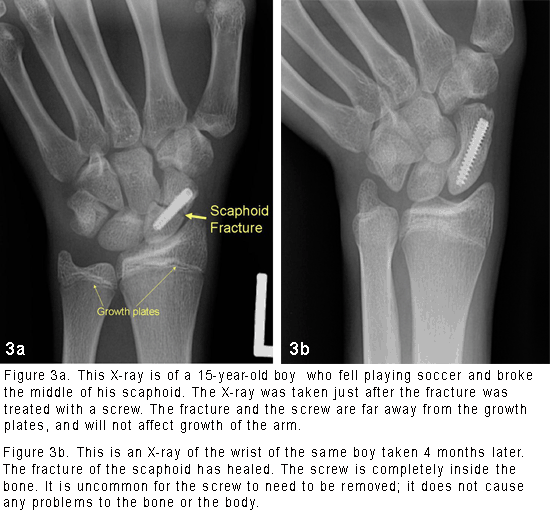
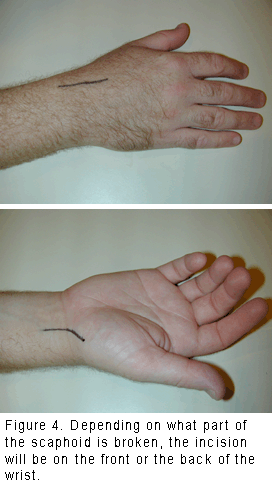
Often, when the scaphoid is broken at the waist or proximal pole, an orthopaedist will recommend surgery using a screw or wire to stabilize the scaphoid from the inside while the bone heals (see Figure 3). Depending on what part of the scaphoid is broken, the incision will be on the front or the back of the wrist (see Figure 4). Sometimes the screw or wire is placed with just a small incision.

Other times a bigger incision is needed to ensure that the pieces of the scaphoid are put back together well. Usually your wrist will be placed in a cast after the surgery, sometimes for a few months. Even with surgery, fractures in this area can take a long time to heal, and it is possible that a nonunion or avascular necrosis will occur.
cons1_386_253

If the scaphoid does not heal, either with or without initial surgery, your orthopaedist may recommend an operation to add bone graft to the scaphoid to help it heal. The surgeon may order an MRI or CT (computed tomography) scan to show more detail about position of the broken pieces of the scaphoid, to help plan the operation. Many kinds of bone graft can be used–your surgeon will discuss which one is best for you. Bone graft may be taken from a bone in the forearm or the pelvis or it may be manufactured. Sometimes a special kind of bone graft with its own blood supply (vascularized graft) may be used.
cons2_386_253

Nonunions, Avascular Necrosis and Arthritis
A bone that fails to heal is called a nonunion; this happens more often in scaphoid fractures than in fractures of many other bones. To heal properly, the bones need blood to carry oxygen and nutrients to the site of the fracture. The scaphoid bone has a poor blood supply. When the scaphoid is broken, especially when broken parts have moved apart (displaced), the blood supply may be disrupted.

Sometimes, the blood supply to one of the broken pieces is so poor that the piece does not get enough nutrients and the cells in the piece die. This is called avascular necrosis. Both nonunion and avascular necrosis of the scaphoid can lead to arthritis of the wrist.

Symptoms of arthritis in the wrist that results from scaphoid nonunion or avascular necrosis include:

  • Aching in the wrist
  • Decreased range of motion of the wrist
  • Pain with activities such as lifting or gripping

If X-rays show arthritis in the wrist because of an old break in the scaphoid, treatment focuses on improving the symptoms of arthritis. At first, this may include taking anti-inflammatory medicine (such as ibuprofen) and wearing a splint when the wrist is painful. Sometimes the doctor may give you a steroid injection into the wrist to help to lessen wrist pain. If this does not work, the doctor may recommend surgery. Many types of operations can be performed for wrist arthritis. Your surgeon will discuss the risks and benefits of the surgery that will be most helpful to you.

Rehabilitation
You will have to wear a cast or splint while the scaphoid fracture is healing, perhaps for as long as six months. Your doctor will give you specific limitations.

Most commonly, you should:

  • Avoid heavy lifting, carrying, pushing, pulling or throwing with the injured arm
  • Not participate in contact sports
  • Not climb ladders or trees
  • Avoid activities with a risk of falling onto your hand (for example, inline skating, jumping on a trampoline.

Some people have stiffness in the wrist after scaphoid fractures; this is more common when a cast was needed for a long time and when surgery was done through a long incision. Your orthopaedist may recommend hand therapy to help regain the motion and strength in your wrist. Even with therapy, some people do not recover the same motion and strength in their wrist that they had before the injury.

Research on the Horizon/What’s New?
Some orthopaedists are placing a screw in the scaphoid through a very small incision–about one-fourth to one-half inch. This may decrease the chances of long-term stiffness in the wrist by decreasing the time that a full-time cast needs to be worn. This is done using a special X-ray machine during surgery to help guide the placement of the screw. Some surgeons use this method even when the broken pieces of the scaphoid are out of place. By looking directly at the scaphoid with a tiny camera (an arthroscope), the surgeon can tell when the broken pieces are lined up.

There is a lot of research being done about the best way to treat fractures of the scaphoid that are not healing well. Some of this research looks at different types of bone graft, including vascularized grafts. New types of manufactured bone graft with special bone cell components to increase healing are being tried to help bones that are not healing.

Replantation Surgery

What is replantation?
Replantation refers to the surgical reattachment of a finger, hand, or arm that has been completely cut from a person’s body. The goal of replantation surgery is to give the patient back as much use of the injured area as possible. In some cases, replantation is not possible because the part is too damaged.

If the lost part cannot be reattached, a patient may have to use a prosthesis (a device that substitutes for a missing part of the body). In some cases, a prosthesis may give a person without hands or arms the ability to function.

cons1_74_51Replantation is usually recommended when the replanted part will work at least as well as a prosthesis. Generally, a missing hand would not be replanted knowing that it would not work, be painful, or get in the way of everyday life. Before surgery the doctor, if possible, will explain the procedure and how much use is likely to return following replantation. The patient or family member must decide whether that amount of use justifies the long and difficult operation, time in the hospital, and months or years of rehabilitation.
How is the procedure done?
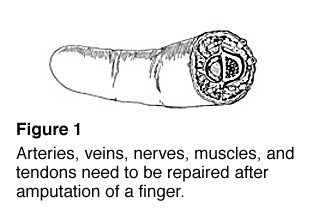
There are a number of steps in the replantation process. First, damaged tissue is carefully removed. Then bone ends are trimmed before they are rejoined. This makes putting together the soft tissue on either side of the wound easier. Arteries, veins, nerves, muscles, and tendons are sewn back together (Figure 1). Areas without skin are covered with skin that has been taken from other areas of the body. Uncovered nerves, tendons, and joints may be covered by a free-tissue transfer, where a piece of tissue is removed from another part of the body, along with its artery and veins.

What kind of recovery can I expect?
The patient has the most important role in the recovery process. Smoking causes poor circulation and may cause loss of blood flow to the replanted part. Allowing the replanted part to hang below heart level may also cause poor circulation. Younger patients have a better chance of their nerves growing back, they may regain more feeling, and may regain more movement in the replanted part.

Generally, the further down the arm the injury occurs, the better the return of use to the patient. Patients who have not injured the joint will get more movement back than those who have. A cleanly cut part usually works better after replantation than one that has been crushed or pulled off.

Recovery of use depends on regrowth of two types of nerves: sensory nerves that let you feel, and motor nerves that tell your muscles to move. Nerves grow about an inch per month. The number of inches from the injury to the tip of a finger gives the minimum number of months after which the patient may be able to feel something with that fingertip. The replanted part never regains 100% of its original use. Most doctors consider 60% to 80% an excellent result. Cold weather can be uncomfortable and a frequent complaint even for those with excellent recovery.

What about therapy and rehabilitation?
Complete healing of the injury and surgical wounds is only the beginning of a long process of rehabilitation. Therapy and temporary bracing are important to the recovery process. From the beginning, braces are used to protect the newly repaired tendons and allow the patient to move the replanted part. Therapy with limited motion helps keep joints from getting stiff, muscles moving, and scar tissue to a minimum.

Even after you have recovered fully, you may find that you cannot do everything you wish to do. Tailor-made devices may help many patients do special activities or hobbies. Talk to your physician or therapist to find out more about such devices. Many replant patients are able to return to the jobs they held before the injury. When this is not possible, patients can seek assistance in selecting a new type of work.

Are emotional problems common following replantation?
Replantation can affect your emotional life as well as your body. When your bandages are removed and you see the replanted part for the first time, you may feel shock, grief, anger, disbelief, or disappointment because the replanted part simply does not look like it did before. Worries about the look of a replanted part and how it will work are common. Talking about these feelings with your doctor often helps you come to terms with the outcome of the replantation.

Your doctor may also ask a counselor to assist with this process. You may find it helpful to talk about it with someone and work through your feelings so you can move on with your life.

Will additional surgery be necessary?
Some patients who have fully recovered from replantation surgery may need surgery later to reach full usage of the part.

Some of the most common procedures are:

  • Tenolysis – frees tendons from scar tissue.
  • Capsulotomy – releases stiff, locked joints.
  • Tendon or muscle transfer – moves tendons or muscles to another spot so that they can work in an area that needs the tendon or muscle more.
  • Nerve grafting – replaces a scarred nerve or a gap in the nerves to improve how the nerve works.
  • Late amputation – removing the part later because it does not work or has become painful.

Stay in the flow of life. You have many great gifts. Even with the best medical care, you need to be strong during the course of recovery. Remember that quality of life is directly related to your attitude and expectations—not just regaining limb use.